Transferring powders and other bulk materials from floor level up and into a hopper, feeder, mixer, reactor, or other destination ranks among the most common material transfer applications. Yet selecting the ideal solution to move the material from point A up and in to point B from the wide variety of conveying options available often confounds even experienced powder handling professionals – especially those under pressure to place safety, throughput, automation, dust control, contamination prevention, ease of use, and cost all among the top priorities. Each conveying approach offers distinct capabilities and characteristics that either support its use for a given up and in application or disqualify its use as inefficient, ineffective, or even outright dangerous.
In many food, chemical, pharmaceutical, and other manufacturing plants, the most common up and in type of installation still involves a worker carrying bagged powders, pellets, and other bulk materials up stairs onto a mezzanine, or up a ladder, then dumping the dry solids into a surge hopper, feeder, or directly into a tank, mixer, or reactor. Though simple and seemingly inexpensive, this manual approach invites serious health and safety risks proven to cause expensive workers’ compensation claims and exposes the company to liability.
Hauling 50-lb bags of flour or sugar over the shoulder and up stairs creates a high risk of slips, trips, falls, back injuries, and a variety of other ergonomic concerns. Emptying the bag and loading the materials into the hopper or port by hand often exposes workers to contact with the material as a cloud of airborne dust and/or as a dusty layer blanketing his or her clothing. If ignitable powders and combustible dusts are involved, then a static discharge caused by the sliding action of emptying powders from bags becomes a real threat to trigger an explosion. Loading the material into an existing mixture or liquid also invites vapor exposure and may generate a hazardous splashing effect. A conveying approach that automates this material transfer process can substantially reduce the lifting, carrying, and dust exposure associated with manual handling, when the complete system is properly designed and operated.
In addition to protecting workers from exposure to the material, it may be equally important to protect the material from exposure to workers and to the workplace. Many materials are highly sensitive to contact with air or moisture and even short-term exposure during the up and in transfer process may compromise their material properties.
For example, exposure to moisture can cause sensitive powders to clump, which may adversely impact flowability and alter how the ingredients interact in the recipe. Materials requiring controlled oxygen or moisture conditions need an appropriately engineered conveying atmosphere; an enclosed system alone does not provide that control.
Some applications call for metering or dosing materials into a process and this can pose an especially challenging task for workers emptying the materials from bags by hand. Loading minor and/or micro-ingredients into a mixer, for example, often requires attention to proper dispersal to ensure the targeted homogeneity is achieved. Erratic loading or imprecise manual measurements may leave key ingredients unmixed in a finished product that ultimately needs to be discarded as waste. The diversity of materials, recipes, production targets, and of the myriad up and in applications, along with the challenges of manual powder handling, have led to the development of a diverse range of conveying solutions to match the ideal conveyor to the application.
While worker safety and contamination control often factor into the decision to upgrade from a manual material transfer process to an automated conveying system, the primary driver justifying the investment is often throughput. As companies grow and need to scale, or as consumer demand for a niche, regional product takes off nationally, the manual method simply cannot deliver the increased production volume required.
Consider the process engineer for a nutritional products manufacturer, for example, who needs to transfer large amounts of a protein powder from the discharge under a mixer or dryer up and in to the nearby hopper above a vertical form fill seal machine on a packaging line. Several different conveying methods may be suitable:
A traditional belt conveyor can transfer bulk materials at high throughput rates, depending on the material, belt width, and belt speed. In this protein powder case, to raise it from the floor level under the mixer up to the hopper of the nearby filling machine, a conventional belt conveyor may require an incline that allows the powder to slide down and off of the belt. Or, to prevent this, a longer conveying length could be used to allow for a gentle incline, but this may require too great a distance to suit the application. Specialized belt designs may offer other options.
A bucket elevator excels in transferring bulk materials vertically and is, therefore, often specified to accommodate tight space constraints. It consists of a series of buckets attached to a belt or chain that lifts the material up to the desired height and discharges at the top. Bucket elevators are available in both open and enclosed designs, with different levels of containment and sanitation.
For food products, the process engineer needs to evaluate protection against humidity, contact with the surrounding environment, lubricant contamination, pests, and product spillage. In this case when transferring a protein powder for human consumption, the selected enclosure and loading and discharge arrangements need to support the required level of cleanliness and sanitation.
Further, cleaning the individual buckets for product changeovers needs to be considered when evaluating the design.
If exposure to the open air needs to be avoided, how about an enclosed approach that reduces the risk of contamination? A flexible screw conveyor is one example of an enclosed material transfer approach. This bulk material handling system transfers the materials from a hopper at floor level up a rotating screw conveyor set inside a plastic tube to discharge at the top. This helps prevent exposure to contamination during transfer, though loading the material in the hopper is typically performed manually and may generate a dust cloud depending on the material. It can move materials horizontally or at an incline to navigate space constraints, with the appropriate angle and throughput determined by the material and screw design.
Performance with mixtures and materials with wide particle size distributions depends on the selected configuration. Some material may remain in the conveyor after the hopper has been emptied, so product retention and access for cleaning need to be evaluated for the application.
What about a conveyor alternative that’s enclosed for contamination control but can also handle transferring materials at a variety of angles including vertically, and even around corners, if necessary?
A tubular drag conveyor offers an enclosed conveyor system that uses a continuous loop of cable or chain with attached discs set inside a tube. As the cable or chain moves, it pulls the discs, which carry the bulk materials up and into the destination. This mechanical conveyor provides gentle transfer for sensitive products, it can accommodate several curves and bends, and can be used in sanitary operations. Though it checks several critical boxes in our protein powder transfer system, its capacity and cleaning requirements need to be evaluated against the application.
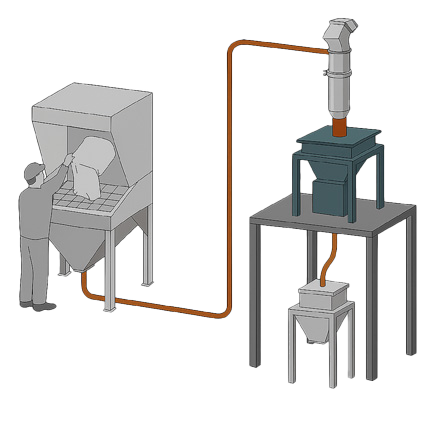
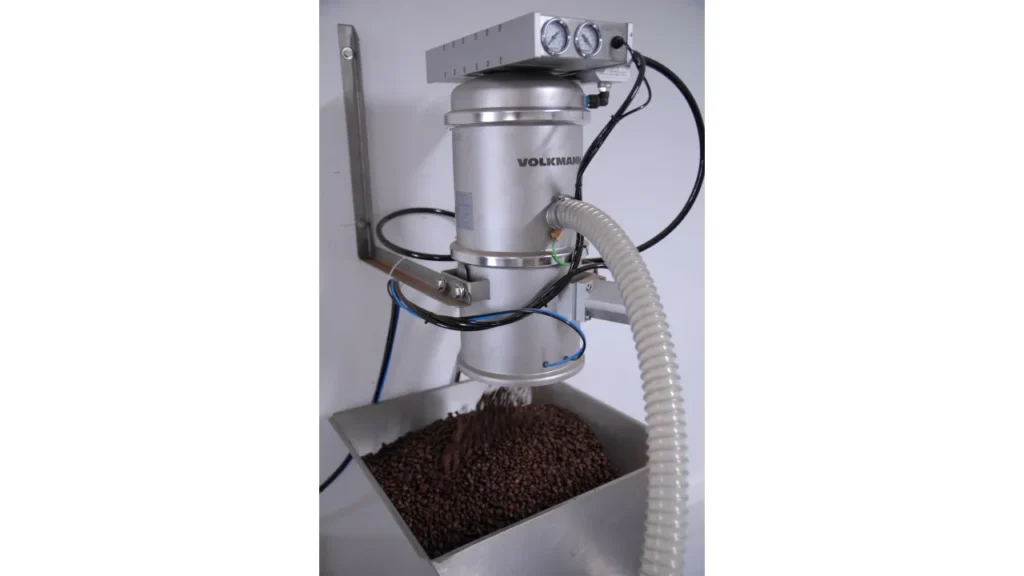
A pneumatic vacuum conveyor uses a vacuum pump to create negative pressure that draws powders, granules, pellets, and even small components from the pickup point up through enclosed tubing and into a receiver for discharge. As an enclosed system, vacuum conveying provides containment to help safeguard against product contamination and reduce worker exposure and nuisance dust. Appropriate containment at the loading and discharge points is also important. Without belts, chains, cables, or conveying screws along the transfer line, this approach offers material transfer in a choice of dense phase or dilute phase. Conveying velocity and operating conditions are selected to achieve the required throughput while protecting particle integrity.
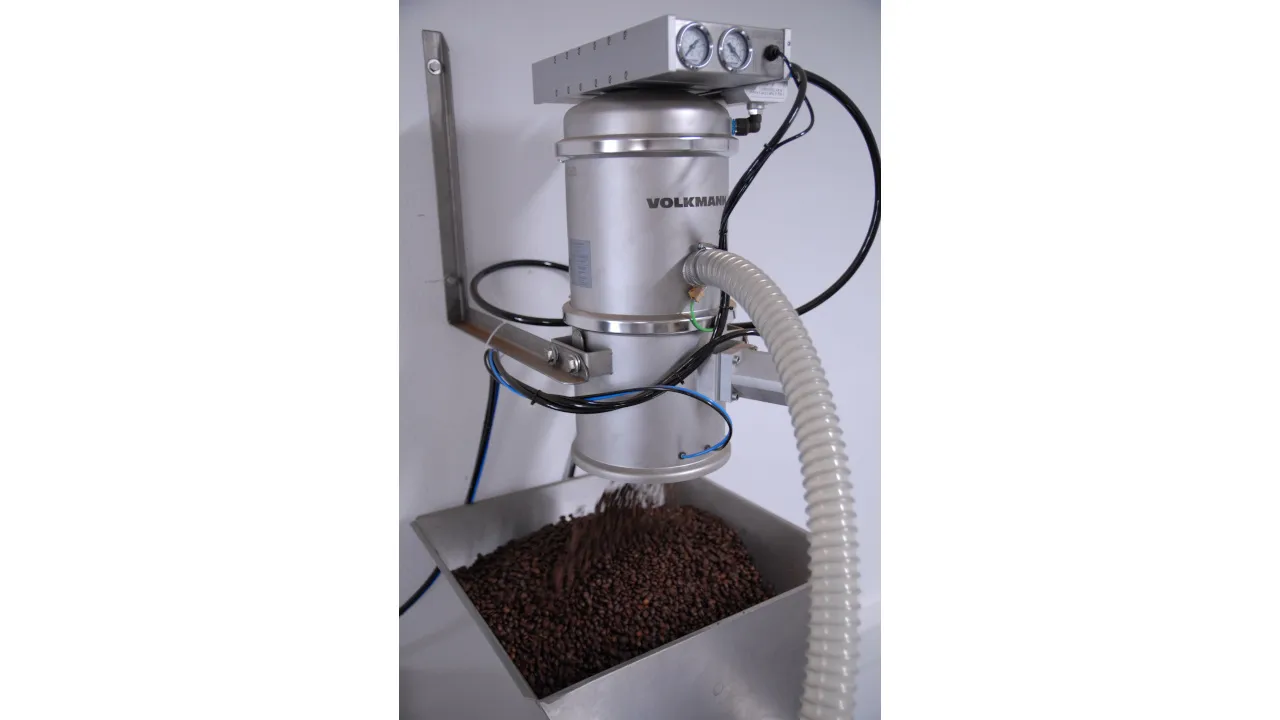
Standard Volkmann systems collect and discharge material in cycles; dedicated continuous systems are available where continuous pickup and discharge are required. Maintenance requirements can be reduced, although filters, seals, valves, and other components still require inspection and service. Product-contact surfaces include hygienic stainless steel and suitable nonmetallic components. Vacuum conveyors that use flexible tubing can fit into compact spaces and effectively transfer materials up vertical inclines and through a number of curves and bends into the discharge. For the example case transferring protein powder from a mixer up and into a hopper, a properly selected pneumatic vacuum conveying system can offer the throughput, gentle conveying, and product containment required, and accommodate steep angles and vertical configurations that fit tight spaces.
It excels in sanitary processes and can improve efficiency and worker safety versus manual methods. Combustible dusts and ignitable powders require application-specific assessment. Volkmann specifies conditions for standard VS and PPC systems, including material minimum ignition energy greater than 1 mJ and the absence of flammable gases; applications involving solvents or flammable gas atmospheres may require INEX inerting systems or other measures.
In addition, modular vacuum conveying systems suit a wide variety of applications with little to no customization. These systems are designed for straightforward installation and operation, with the required configuration, process interfaces, and level of engineering support determined by the application. Material testing can help confirm conveying performance.
Vacuum conveying’s alter ego, positive pressure pneumatic conveying, uses pressurized air to push materials through the piping or tubing from one point to another rather than draw it from the discharge end with a vacuum pump. This approach offers contained conveying in either dense phase or dilute phase, with handling characteristics dependent on the material and system design.
It is often considered when materials need to be transferred long distances at high throughputs. Equipment footprint, energy use, and installed cost should be compared for the specific duty. For the protein powder installation, the engineer needs to determine whether its capacity and configuration suit the application.
From this review of conveying systems for transferring bulk materials up and in to process or packaging equipment, it is clear that several different approaches could be used to meet the application’s requirements, though some are more efficient and effective than others. Thinking an automated approach is too costly, it is easy for many managers to overlook the hidden expenses involved with a labor-intensive, manual process.
The average cost of a lost-time workers’ compensation claim caused by falls or slips in the US was $57,314 for accidents occurring in 2023 and 2024, according to the National Safety Council, using NCCI data. The potential cost of an injury is another consideration when evaluating the investment in an automated conveying system.
When also considering potential improvements in efficiency, productivity, and quality, and the cost savings in labor, automating the material transfer process can offer an attractive return. The payback period should be calculated using the installation cost, operating expenses, and expected savings for the specific application.
Dave Nichols is a Senior Sales Engineer for Volkmann USA. The company designs and manufactures pneumatic vacuum conveying systems, vibratory weigh feeders, and other process equipment. For more information, call 609-265-0101 or email contact@volkmannusa.com.
A comparable version featured in: