
609-265-0101​

Search
Pneumatic Vacuum Conveying Lessons Not Taught in Engineering School

While engineering schools typically focus on foundational principles, designing conveyors and other bulk material handling machinery that works in the real world demands hands-on experience and an instinct for problem-solving.

As featured in:

At a Glance

  • Engineers learn knowledge and thoroughness in school but develop wisdom from applying it in practice.
  • To design a pneumatic vacuum conveying system, two important factors are needed at the outset.
  • There are no formulas or calculations that can factor every conceivable material property or conveyor configuration.
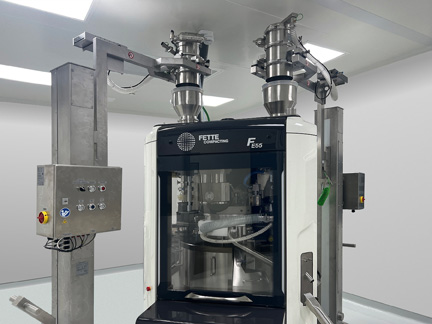
Volkmann Tablet Conveyor
This system uses negative pressure to transfer mixed powders up and into a tablet press and gently transfer the finished tablets to packaging.

Dominick Fortuna, Volkmann PresidentI was standing before the pickup point of a pneumatic conveying system we had supplied to a manufacturer in Canada, trying to figure out why it wasn’t working as expected.

It was a dense phase conveying system with an extensive network of piping and multiple vertical runs that demanded a high airflow rate to transfer the powder across a great distance. The airflow rate was especially high at the pickup point — too high, it turned out — to properly form the powder into the pulsed plugs characteristic of gentle, dense phase conveying.

Reducing the airflow to try to help form proper plugs wouldn’t allow powder to reach the discharge. Several troubleshooting ideas were tried but to no avail.

It was barely a year since I’d graduated from the Rensselaer Polytechnic Institute (RPI) School of Engineering, and I thought to myself, “Well, this wasn’t covered in class.”

After considering several different adjustments, we reconfigured the piping to place the first vertical run much closer to the pickup point. It seemed counter-intuitive, but it allowed the system to form proper plugs while operating with the required airflow and minimized the effect of the pressure drop during the vertical run.

Looking back, I realized the curriculum of even the world’s most rigorous engineering school, with its intense focus on understanding foundational principles of physics and the corresponding mathematical calculations, taught very little about the practicalities involved in using pneumatic conveying to safely transfer bulk materials across a vast chemical processing plant.

Knowledge vs. Experience

Engineers learn knowledge and thoroughness in school but develop wisdom from applying it in practice and humility from recognizing that what works perfectly on screen or in a computer model may not neatly translate to the real world. That’s why having experience and an instinct for problem-solving are critical for designing powder handling equipment that works as intended not only on screen and in a test laboratory but also for years after installation.

RPI isn’t the only engineering school that focuses on principles and calculations and often leaves practical, hands-on experience to internships and post-graduate work. Here are some insights into several other powder and bulk solids conveying issues that aren’t typically taught in engineering school but would be useful for bulk material handling professionals to understand.

When to Specify Pneumatic Vacuum Conveyors

Most of us learned a great deal about fluid dynamics in school but never discussed how to harness air and/or vacuum (negative pressure) to transfer materials from point A to point B inside an enclosed hose or pipe. Yet these are often the most efficient of all conveying methods available to the bulk solids industry today, depending on the application. They offer a high level of dust control, cleanliness, containment, and contamination prevention that mechanical conveying methods such as bucket elevators and belt conveyors cannot match. These pneumatic air conveyors may be divided into two types: positive pressure pneumatic conveyors, which use compressed air to push bulk materials from pickup to discharge, and negative pressure vacuum conveyors, which use a vacuum pump to draw the bulk materials via suction flow from pickup to discharge.

Both variations excel in transferring powders, pellets, granules, and other dry, bulk materials, both may operate in lean and dense phase, and a measure of crossover exists whereby either type may suit the same application. But, in most cases, one type typically offers an advantage over the other.

Positive pressure systems are used to transfer plastic resin pellets, aggregates, and other materials over long distances, albeit with high conveying velocities that can cause increased product degradation. Negative pressure vacuum conveying systems are used to transfer more sensitive, high-value materials and ingredients when particle size and shape matter and degradation needs to be minimized. If any leaks occur in the pipeline, then a negative pressure vacuum conveying system will pull outside air into the line, while a positive pressure conveying system will blow product out of the pipeline — a significant advantage for vacuum conveying when the product is an explosion hazard or toxic. Flour, spices, active pharmaceutical ingredients and finished tablets, and pigments are examples where gentler vacuum conveying offers an advantage. Both types, though, are proven effective in transferring thousands of different materials with a diverse range of properties.

This sealed, explosion-proof system integrates a bulk bag unloader with a pneumatic vacuum conveyor to transfer the powder from the bag directly into the process.

Calculating Pneumatic Conveyor Size

Technology and engineering schools require students to memorize a dizzying array of formulas and calculations. It’s a point of pride. In fact, the cheer that RPI students often shout at hockey games cites advanced mathematics concepts. And while many of the formulas and concepts taught in school apply to designing conveying systems in principle, the key calculation used every day to size our vacuum conveying systems is a relatively simple one. This is called Volume

Throughput: Volume = Rate x Bulk Density

This means that to design a pneumatic vacuum conveying system, the two most important factors needed at the outset are the bulk density of the material and the amount that is to be transferred through the conveyor. For example, if a food manufacturer needs to transfer pasta pieces from an extruder at a rate of 2,500 lb/hr and the bulk density is 65 lb/ft³, the system needs to be able to transfer at a rate of about 38 cubic feet per hour.

Experienced engineers can design a conveying system to accommodate nearly any volume throughput desired. However, higher throughput rates require larger equipment and pipe sizes, and higher airflows that can lead to increased system velocities. This increases the risk of particle degradation, increases the energy input required, and, when transferring mixtures, increases the likelihood that the different materials will separate from suspension during transfer, especially when moving multiple materials with different bulk densities.

How do manufacturers know what volume throughput is desired? This is often determined by the throughput rate of equipment upstream and/or downstream. When transferring dry pasta to a process kettle, for example, the volume throughput of the conveying system would typically need to match the throughput rate of the process kettle plus a certain amount of buffer capacity to cover for upset conditions. Transferring too slowly would leave the kettle idle or leave a portion of the pasta uncooked, while transferring too fast could also disrupt the requirements of the recipe. Similarly, there would be no need to design the vacuum conveyor to handle a volume throughput far exceeding the rate that upstream equipment can feed material to the conveyor, while, conversely, the conveyor would be overwhelmed if the material flow from upstream exceeded the conveyor’s capacity.

Once the volume throughput is determined, we can factor into the equation the conveying distance from point A to point B, any elevation changes needed between point A and point B, and additional material properties such as sensitivity to humidity, or particle size and shape, and required particle size distribution at the discharge.

Engineering as Art

There are no formulas or calculations, however, that can factor every conceivable material property or conveyor configuration into the equation. At this stage, engineering expertise, experience, and critical thinking play key roles in ensuring the conveying system design meets the targeted throughput and product quality requirements upon installation and commissioning.

Since Volkmann has decades of accumulated powder handling experience, we have a library of technical data sourced from conducting tests with thousands of different materials and ingredients. The company’s engineering team knows exactly how wheat flour, versus fine cake flour, or fly ash versus carbon black will behave in a pneumatic vacuum conveying system. The team already knows how to account for both subtle and substantial differences in material properties, even of slightly different grades of the same material, and even when conveying in high altitude or tropical environments.

This matters because the inputs often change after scaling and installation. Consider a conveyor designed to transfer wheat flour from 50-lb bags up and into a mixer based on a given bulk density. During the summer, high humidity causes the bagged wheat flour to absorb moisture in storage, affecting flow characteristics and impacting the bulk density. A different bulk density, as the key factor in the most important calculation for sizing a vacuum conveyor, changes how the wheat flour behaves during conveying and may compromise flowability. Or, what if the bakery switches wheat flour suppliers to save money and the new supplier uses a wider particle size distribution containing far more fine particles than anticipated? For companies to confidently replace manual powder handling with automated vacuum conveyors, the conveying system needs to be versatile enough to accommodate these very predictable fluctuations in material properties, as well as the unpredictable changes that occur. Experience, in these cases, is usually the best teacher.

Properly designing several types of conveying systems commonly used to transfer materials throughout industry requires a high level of technical expertise, yet this isn’t adequately covered in most engineering schools. When tasked with evaluating and specifying the ideal conveying approach for a particular application, combining practical, hands-on experience with solid fundamentals in mathematics and physics, and supported by thorough laboratory testing, offers a sure path to a successful outcome.

Picture of Dominick Fortuna

Dominick Fortuna

Dominick Fortuna is president of Volkmann USA. He's a graduate of the Rensselaer Polytechnic Institute (RPI) School of Engineering and has nearly three decades of experience in project engineering and management with a focus on plant design, optimization, and equipment specification. Volkmann designs and manufactures pneumatic vacuum conveying systems, vibratory weigh feeders, and other process equipment. For more information, call 609-265-0101or visit www.volkmannusa.com.

As featured in:

Volkmann Tablet Conveyor
This system uses negative pressure to transfer mixed powders up and into a tablet press and gently transfer the finished tablets to packaging.
This sealed, explosion-proof system integrates a bulk bag unloader with a pneumatic vacuum conveyor to transfer the powder from the bag directly into the process.