Invest Millions to Automate Production Yet Workers Still Haul 50 lb. Bags?
What an impressive sight! Walking into the massive food industry trade show, we were immediately awestruck by the multi-million dollar, fully automated processing and packaging line that was running non-stop at one of the largest booths in the show. Turning the corner, we came across yet another company running a multi-million dollar, fully automated processing and packaging line at its equally spacious booth. And then another. And then one more. The myriad conveyors, feeders, ovens, coolers, cartoners, and other machines dancing in sync created a sight to behold rivaled only by the aromas of fresh cakes, cookies, and loaves of bread coming off the lines with speed and precision.
Automated Ingredient Handling Supports Efficient Production
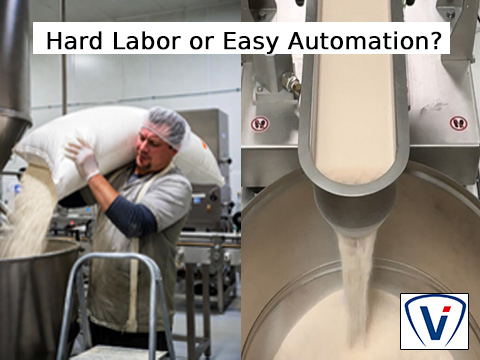
All of these competing equipment companies, we later learned, have been doing quite well. For a number of years, food, pet food, bakery, and nutritional product manufacturers have been scrambling to automate as many manual processes as possible, even as the level of investment reaches into the millions per plant. Yet few of these fully automated systems we saw address bulk material handling upstream. In many cases, after manufacturers install these pricey automated systems, they still rely on their workers to carry 50 lb. bags over their shoulders every day to load flour, sugar, salt, and other ingredients into the automated part of the process. This manual powder handling approach has proven to invite dangerous slips, trips, falls, back injuries, and other costly safety and housekeeping issues that would send an OSHA inspector into a panic. It’s certainly no way to attract and retain the workers who are willing to show up.
Manual ingredient handling also invites risk of line downtime, leaving the new, automated systems sitting idle if the workers cannot keep pace with the faster throughputs. How much money is lost when the new system isn’t operating while waiting for ingredients from upstream? A seemingly brief two-minute delay reduces equipment utilization, wastes heat energy and electricity, and creates bottlenecks downstream. The costs rise exponentially into the thousands when applied across multiple shifts over time. This isn’t even addressing the hidden costs of potential recipe inconsistencies and product quality variations due to human error.
For a manufacturer justifying multi-million dollar investments in automation as the key to improving efficiency and solving labor woes, failing to address the inherent inefficiencies in manual ingredient handling seems quite an oversight. Even the most advanced automated line can’t deliver anticipated ROI if it’s waiting on operators to deliver ingredients by hand.
How Much Does It Cost to Automate Ingredient Handling?
That’s why our team was surprised when a manager at a food manufacturing company that had invested millions in a modern, fully automated system bristled at the idea that an automated ingredient handling system might run $30,000.00 – a one time investment accounting for barely one percent of the total investment in automating the plant.
Our pneumatic vacuum conveying system for ingredient handling serves as an insurance policy on investment returns ensuring manufacturers capture as much of the production potential and ROI of the new, fully automated production line as possible. Our vacuum conveyors automatically keep the line supplied with the ingredients and our feeders continuously meter them into the mixer, hopper, or other equipment in precise, preset amounts exactly when needed. No over- or under-weighments to jeopardize product quality, fewer line stoppages, less concern for errors, and reduced dependence on manual labor. When operating with automation at high throughputs at scale, the damage from a single human error compounds with a cascading effect that can render huge amounts of product as costly waste.
For a wholesale bakery or other food, beverage, or nutraceutical manufacturer stuck in a vice between rising input costs and a ceiling on consumer spending, supporting plant automation with a Volkmann pneumatic vacuum conveying system seems an obvious solution to controlling costs with a relatively low investment and a short payback period.
Does it make sense for you to consider automated ingredient handling with Volkmann? Contact us here.